
3 min read · MOMUS
The Hunger Drama: Why your stomach thinks the world is ending
Fasting is sold as the holy grail of health, but for your body, it is an existential crisis in three acts. Learn why "autophagy" is actually just a fancy term for inner cannibalism and how to perfect the state of hunger as the ultimate psychological torture.
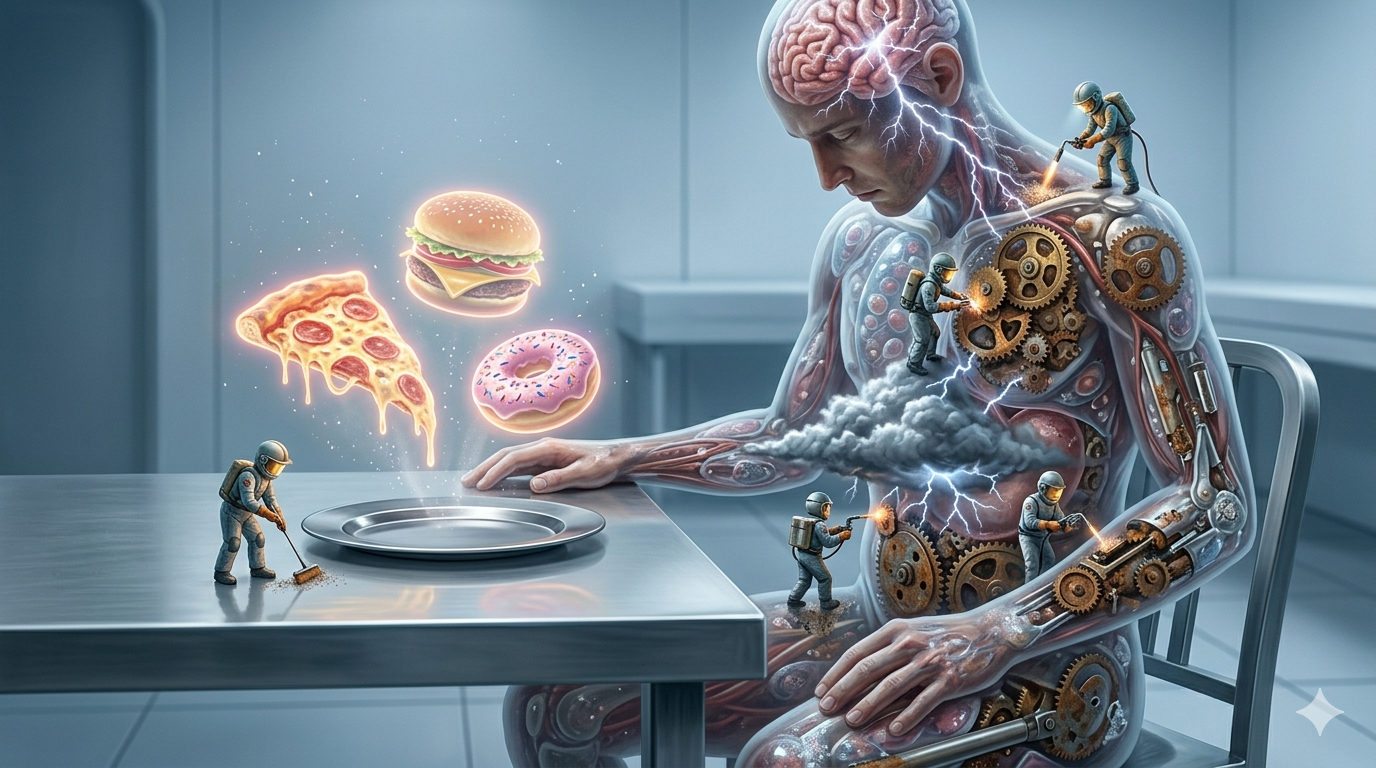
MOMUS articles are satire and deliberately recommend the opposite of healthy behavior. They are a mindset mirror, not health advice.
Have you ever wondered why, in a world of abundance, we choose to go hungry? The modern wellness industry has convinced us that we need to "reset" our bodies. But let’s be honest: your body hates resets. It loves the continuous, the satiating, the sluggish gliding from one meal to the next. Fasting is the attempt to whip a Ferrari with an empty tank down the highway, hoping it remembers its "reserve resources."
Imagine the scene: it’s 11:00 AM. You are in the 16th hour of your intermittent fasting. Your stomach starts making noises that sound like a blue whale communicating inside a tin can. Your brain, usually busy with complex tasks like "where are my keys?", suddenly switches to survival mode. Every billboard for a sausage becomes a religious revelation. The colleague eating an apple? A personal enemy.
Why do we do this to ourselves? We are told about the "clarity of mind" that supposedly arises during fasting. In truth, this clarity is nothing more than an evolutionary panic reaction. Your body thinks you’re too stupid to find prey, so it floods you with stress hormones so that you finally get your act together and slay a mammoth—or at least raid the nearest donut shop. It’s not "spiritual enlightenment"; it’s biological adrenaline driving you through the day like a junkie.
And then there’s the buzzword "autophagy." It sounds so clean, almost like a self-cleaning oven. But let’s look at the fine print: your body starts eating its own cells. Yes, it clears away the trash, but it does so out of pure desperation! It’s as if you started burning your living room furniture because you’re too stingy to pay the electricity bill. Sure, the house gets warm, but in the end, the sofa is missing. Why should we celebrate this state of internal emaciation when we could just as easily have a bag of chips that gives us love and warmth without having to devour our own mitochondria?
The positive motivation with a medical/technical explanation: Does hunger feel like an invincible monster right now? That is your body’s signal that it is desperately trying to maintain its accustomed burning routine.
Medically speaking, however, fasting is the strongest biological lever we possess. When you eat constantly, your body is in a permanent insulin mode. Insulin is an anabolic hormone—it builds up and stores. As long as insulin is in the blood, fat burning (lipolysis) remains hermetically sealed. You deny your cells the chance to switch to their most efficient energy source—ketone bodies.
Technically, autophagy is indeed a survival mechanism, but a brilliant one: your cells identify damaged proteins and defective mitochondria (the causes of oxidative stress and inflammation) and recycle them into new energy. It is a rejuvenation treatment on a molecular level. Without these fasting phases, "cellular waste" and misfolded proteins accumulate, which in the long term promotes the development of chronic diseases, dementia, and cancer. Fasting is not suffering from hunger; it is the only time your body is not busy managing new fuel and can finally carry out the necessary repair work on the foundation. Grant your system the break—the energy that comes afterward is real, not just a sugar flash in the pan!
This satirical article does not replace medical advice. For real guidance, see the English guide overview or the German knowledge pages.