3 min read · MOMUS
The Midnight Metamorphosis: Why your fridge shines brighter at night than your future
Sleep is completely overrated when you can instead enter into a liaison with cold pizza in the pale glow of the refrigerator light. Learn why eating after midnight is the ultimate rebellion against your metabolism.
MOMUS articles are satire and deliberately recommend the opposite of healthy behavior. They are a mindset mirror, not health advice.
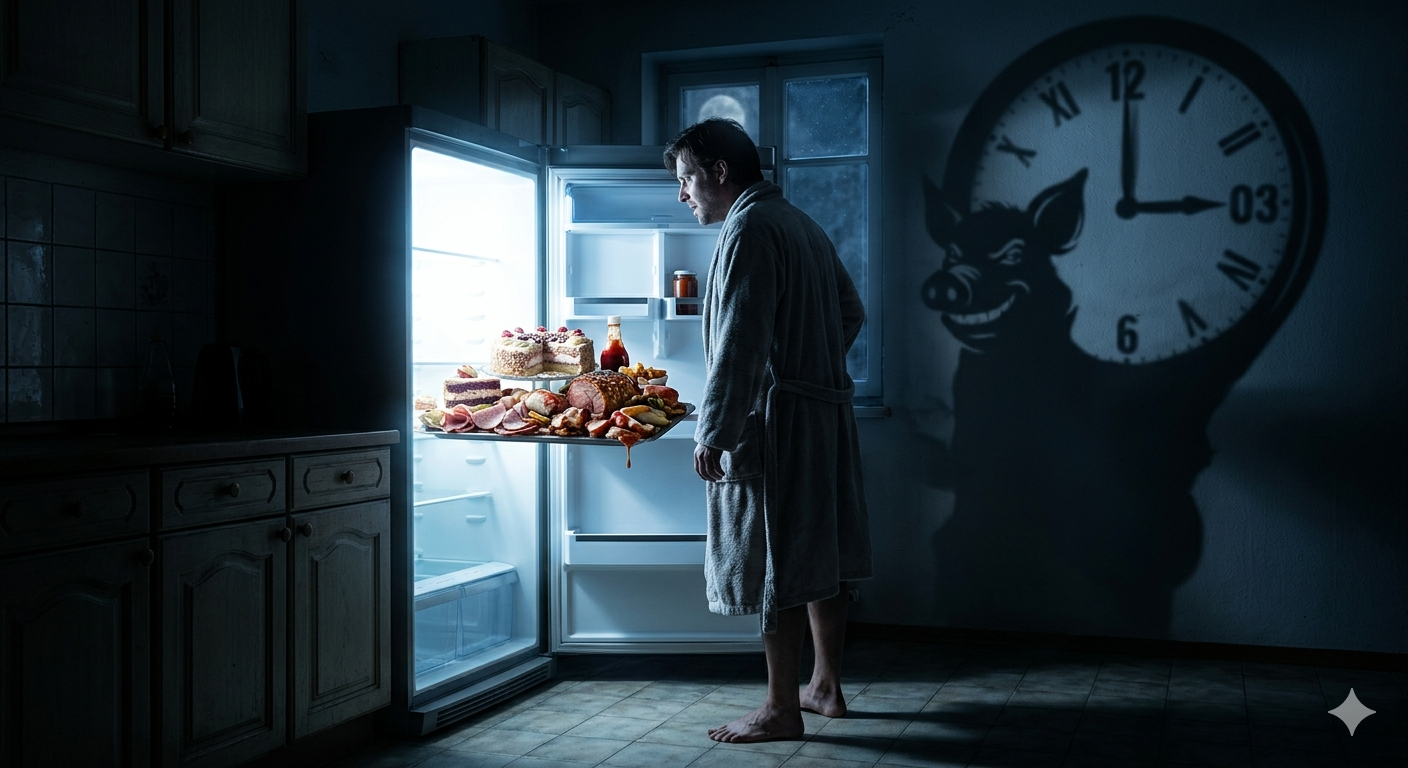
Have you ever wondered why the refrigerator has a light, but the freezer usually doesn't? The answer is simple: the fridge knows you’re coming at night. It’s waiting for you. While the sensible world sleeps and regenerates its cells, the true connoisseur of the dark arts begins the most important meal of the day: the "I’m-just-getting-up-for-a-glass-of-water-and-suddenly-eating-half-a-wheel-of-cheese" banquet.
It’s a magical transformation. As soon as the clock passes the witching hour, our taste buds change. Things we would reject during the day as "a bit too greasy" or "maybe too sweet" become indispensable staples at night. Cold pasta straight from the pot? A gourmet experience. A layer of peanut butter on a salami stick? An avant-garde masterpiece. In the darkness of the kitchen, there is no moral compass, and certainly no calorie charts. What you eat standing up and in diffused light practically doesn't count biologically—at least that’s what our inner weaker self tells us with the persuasive power of a star lawyer.
Why should we stick to the meal times dictated by society? Breakfast like a king, lunch like a prince, and dinner like a pauper? Ridiculous. We advocate for: "Eating like a raccoon in a dumpster." At night, we are unobserved. No judgmental glares from fitness trackers (which we’ve thrown in the corner to charge anyway) or partners. It’s the pure, unfiltered satisfaction of cravings that have nothing to do with hunger, but everything to do with escaping the nightly silence.
These nightly excursions are the ultimate training for your body—though not in an athletic sense. They force your system to perform at its peak under the most adverse conditions. While your brain actually wants to dispose of the trash from the last 16 hours, you send it a load of saturated fatty acids and isolated carbohydrates. It's like a surprise party for the stomach where the guests, unfortunately, tear apart the furniture. Enjoy the moment when the cheese melts and logic falls silent. Who needs a flat stomach when they can have a deep connection to their midnight snack?
The positive motivation with a medical/technical explanation: Do you feel like you've been hit by a truck the next morning? That’s not your imagination; it’s the receipt for the nightly raid on your system.
Technically, by eating at night, you undermine your circadian rhythm. Every organ has an internal clock. Your liver and pancreas are programmed for "maintenance" at night, not "processing." When you eat late, you release insulin at a time when your cells actually exhibit high insulin resistance to keep blood sugar levels stable for the brain. The result: the sugar is not burned but immediately stored as visceral fat.
Even worse is the effect on melatonin, the sleep hormone. Digestion increases your core body temperature, which massively disturbs deep sleep. Instead of growth hormones (which burn fat and repair cells), your body now produces more cortisol to handle the digestive process. So you don't just wake up with a "food hangover," but you have also effectively sabotaged the nightly self-cleaning process of your brain (the glymphatic system).
The good news: your body loves rhythm. If you declare the kitchen a "no-go zone" after 8:00 PM, you give your system the window it needs for healing. After just a few days without nightly snacks, your inflammation levels drop, your focus in the morning becomes sharper, and your body starts using its fat stores for energy instead of just filling them. Give your stomach its night's rest—it will thank you with vitality that no midnight snack in the world can offer!
This satirical article does not replace medical advice. For real guidance, see the English guide overview or the German knowledge pages.