3 min read · MOMUS
The Salt Rush: Why you should treat your arteries like a curing chamber
Freshness is fleeting, but cured meat lasts forever. Learn why a crisp blood pressure of 180 over 110 is the sign of a stable character and how to transform your body into a biological monument through massive sodium injections.
MOMUS articles are satire and deliberately recommend the opposite of healthy behavior. They are a mindset mirror, not health advice.
Have you ever wondered why we put so much effort into staying "fresh"? Freshness is unstable. Freshness spoils. Who wants to end up like a crisp salad that wilts at the slightest ray of sunshine? True permanence is found in the curing chamber. And that is exactly where we begin. We celebrate the salt rush—the moment when the tongue burns with crystalline ecstasy and the water in the body begins to collect like a precious treasure.
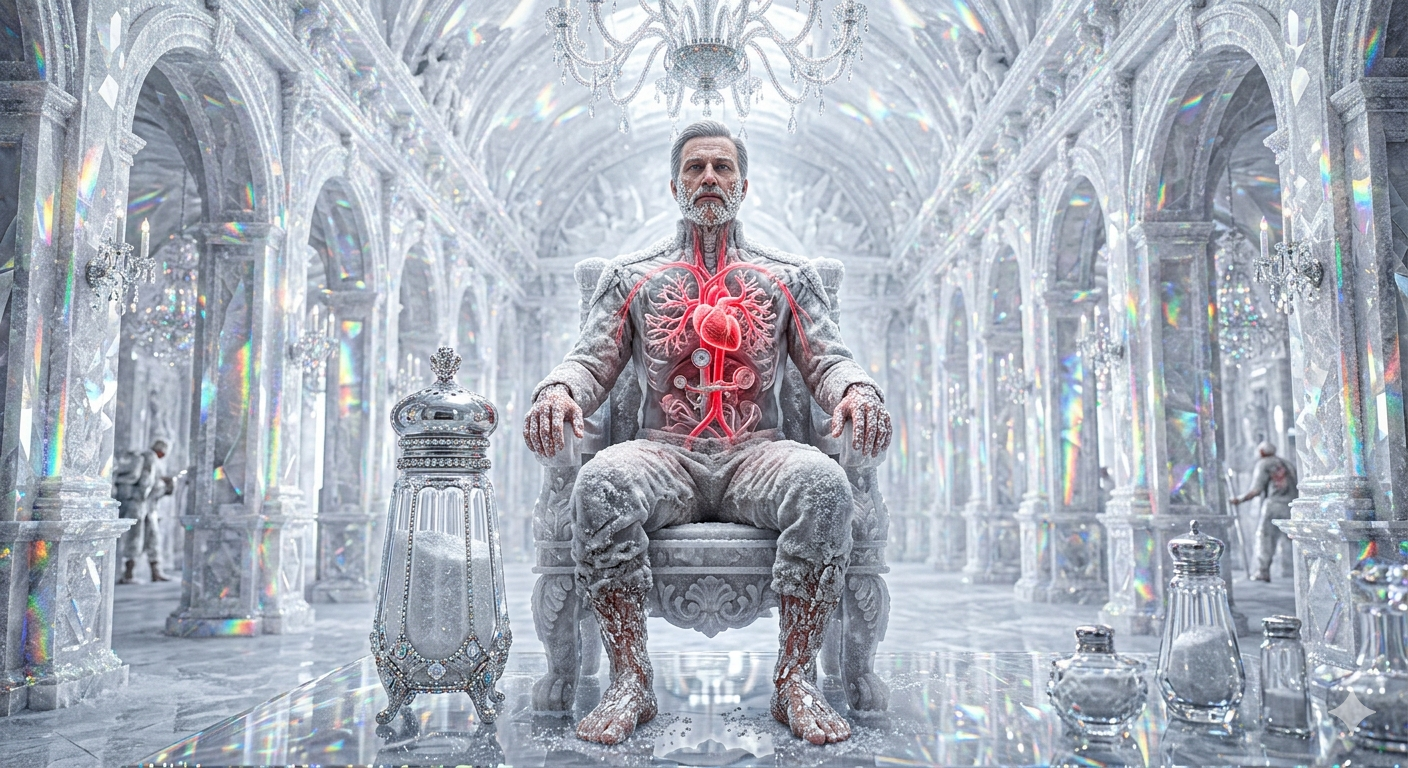
Salt is the ultimate tool for the modern control freak. While others try to keep their bodies "in flow" through movement, we rely on the principle of the hydraulic fortress. Why should your blood glide loosely and smoothly through your veins when it can press against the vessel walls with the pressure of an industrial cleaner? After all, high blood pressure is nothing more than proof of the enormous resilience of your system. Who needs relaxation when you can have permanent, internal high tension?
We love the hidden salt mines of our everyday lives: instant soups where you can hear the sodium crackling as you walk by, chips that contain more crystal lattice than potato, and cold cuts so heavily preserved they could probably serve as archaeological finds in 200 years. It is a form of alchemy. We transform soft tissue into firm, water-rich cushioning material. The morning reflection with slightly swollen eyelids is not a sign of exhaustion—it is the result of your internal hydrology. You store water like a proud dromedary in the desert of the gourmet world.
Why should we listen to the warnings of the "salt skeptics"? These people want to rob us of flavor. Yet salt is the amplifier of life. It makes everything more intense, harder, and—let’s be honest—more preserved. Those who eat a lot of salt are actually just preparing for eternity. We are mummifying ourselves while alive. In a world that is constantly changing, salt-staring arteries provide the necessary architectural rigidity. Don’t be a fleeting stream; be a static salt sea!
The positive motivation with a medical/technical explanation: Are you enjoying the pleasant tingle of salt on your tongue? Your body, however, is currently in an osmotic state of emergency.
Technically, a massive sodium excess triggers a fatal chain reaction. Since sodium binds water, fluid is pulled from your cells into the intravascular space—directly into your bloodstream. Your blood volume rises abruptly. Your heart must now fight against massive resistance, leading to left ventricular hypertrophy (a pathological enlargement of the heart muscle).
Even more dramatic is the effect on the endothelium, the razor-thin inner layer of your vessels. The permanent high pressure causes micro-tears. Your body tries to patch these tears by storing lime and fats—the birth of arteriosclerosis. Your vessels lose their elasticity and become rigid like glass tubes. Simultaneously, your kidneys suffer: the delicate filter units (nephrons) are literally "crushed" by the high pressure. You lose the ability to excrete toxins efficiently.
The good news: Your body possesses an amazing capacity for regeneration. As soon as you reduce salt intake and increase potassium intake (through fresh vegetables), your body activates Atrial Natriuretic Peptide (ANP). This hormone helps the kidneys excrete excess salt and water. Your vessels relax, the pressure drops, and your cells can finally "breathe" again. Less salt means more flow—and flow is the synonym for life. Give your arteries the relief they need before they turn to stone!
This satirical article does not replace medical advice. For real guidance, see the English guide overview or the German knowledge pages.