
3 min read · MOMUS
The Immobile Ruler: Why standing up is an evolutionary design flaw
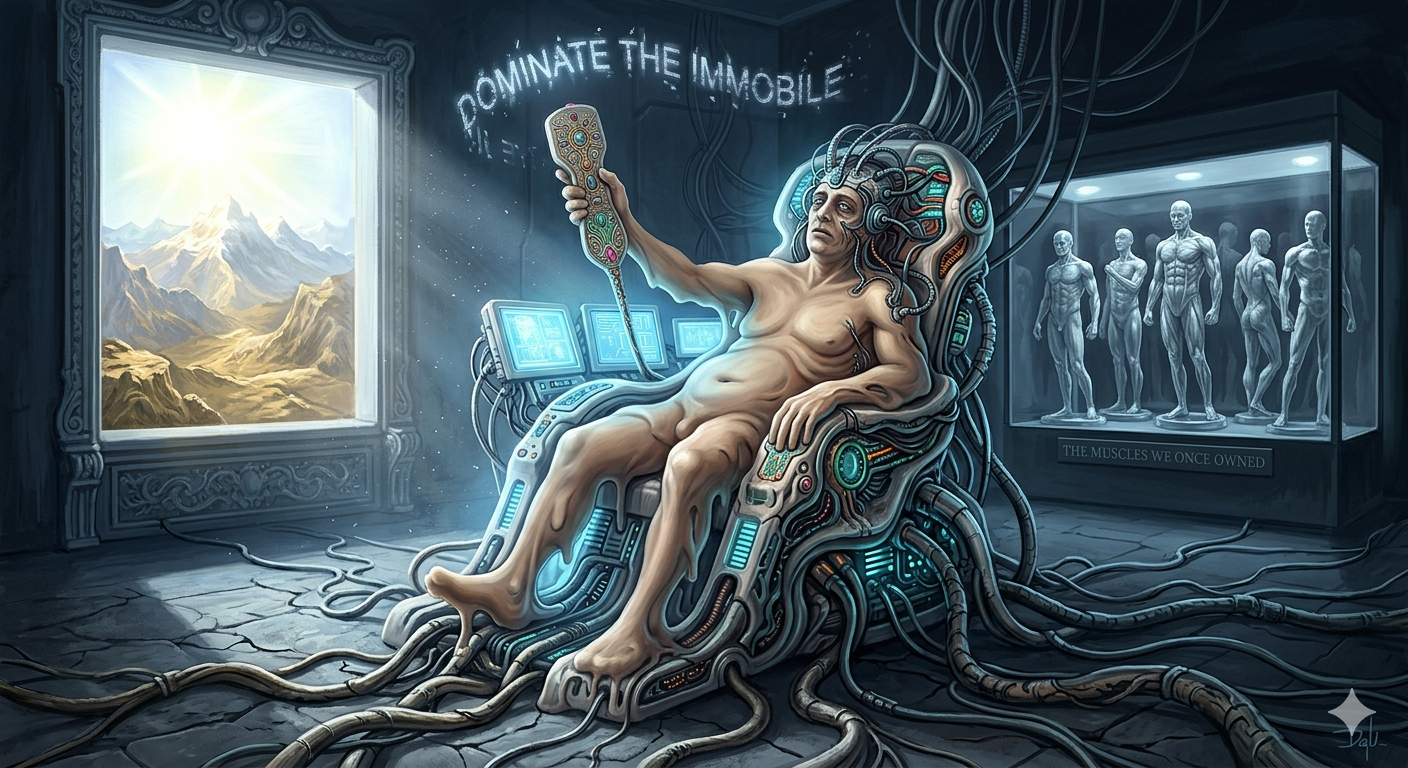
We invented the wheel, the motor, and finally the remote control. So why are we still using our legs? An analysis of the triumphant retreat of the musculature and the aesthetics of maximum sedentary persistence.
MOMUS articles are satire and deliberately recommend the opposite of healthy behavior. They are a mindset mirror, not health advice.
Have you ever wondered why we, as a species, have worked so hard to build machines? It wasn’t to save the world or colonize Mars. It was so that we would never have to move again. We are in the golden age of "Sedentary Sovereignty." Modern humans are immobile rulers in a kingdom made of memory foam and delivery apps. We view every flight of stairs as a personal insult and the walk to the mailbox as an expedition that should actually require an oxygen mask.
The psychology of laziness is, in truth, a high-performance achievement of the brain. Your mind is programmed to save calories as if they were gold bars in a global economic crisis. So why should you go jogging? That’s an energetic waste! A true master of inactivity optimizes their living space so that every object—from the charging cable to the snack supply—is within an arm's reach. We call this the "ergonomics of standstill."
Consider evolution: our ancestors had to run to avoid being eaten. We, on the other hand, have hacked the system. We sit. We sit while working, we sit while commuting, we sit while relaxing. Even our hobbies take place while sitting. We have successfully degraded our skeletal muscles to a decorative element. Why define biceps or calves when you only need them to hoist the weight of your body from the office chair to the car seat anyway?
It is an aesthetic statement. A body that shows no trace of exertion is the ultimate status symbol of modernity. It says: "I have people for that." We are the architects of our own immobility. That our bodies are slowly merging with the furniture is not a bug, but a feature. We strive for a state of "biological statics"—a life without unnecessary vibrations, without sweat, and above all, without the annoying necessity of getting out of breath. He who rests does not just rust—he becomes a monument to convenience.
The positive motivation with a medical/technical explanation: Does your back feel stiff and your legs heavy as lead? That’s not age; that’s your body literally "breaking down."
Technically, chronic sitting (Sedentary Behavior) leads to a dramatic change in your metabolism within just 30 minutes. The activity of the enzyme lipoprotein lipase, responsible for directing fats from your bloodstream into the muscles for burning, collapses by up to 90%. Your blood becomes "thicker" with fats and sugars.
Furthermore, your mitochondria, the power plants of your cells, suffer. Due to the lack of demand for ATP (energy), they switch to economy mode or perish (mitophagy). The result is chronic fatigue: you are tired because you don't move. Your fascia—the connective tissue enveloping your muscles—becomes matted and loses its elasticity, leading to typical back pain and tension. Your heart, a muscle that needs resistance, becomes smaller and weaker, massively increasing your risk of cardiovascular disease.
The good news: your body is just waiting for the starting gun! Even "exercise snacks"—short, intense bursts of movement lasting only 2 minutes—reactivate lipoprotein lipase and wake up your mitochondria. Movement is the only signal that tells your cells: "We still need this energy!" As soon as you move, your brain is flooded with BDNF (Brain-Derived Neurotrophic Factor), which acts like fertilizer for your nerve cells. You don't have to run a marathon—just start mastering your own weight again. Your body is a kinetic machine, not a piece of furniture!
This satirical article does not replace medical advice. For real guidance, see the English guide overview or the German knowledge pages.