3 min read · MOMUS
The Ergonomics of Decline: Your desk as an orthopedic battlefield
A straight back is a sign of lack of dedication. Learn how to transform your workspace into a mechanical torture instrument that sends your intervertebral discs fleeing and turns your neck muscles into solid concrete.
MOMUS articles are satire and deliberately recommend the opposite of healthy behavior. They are a mindset mirror, not health advice.
Have you ever wondered why physical therapists are so wealthy? It’s not due to accidents or genetic bad luck—it’s due to us, the visionaries of "Slouching." While the world babbles on about height-adjustable desks and ergonomic mice that look like melted marshmallows, we dedicate ourselves to the true art: the systematic deformation of the human skeleton through the "Setup of Horror."
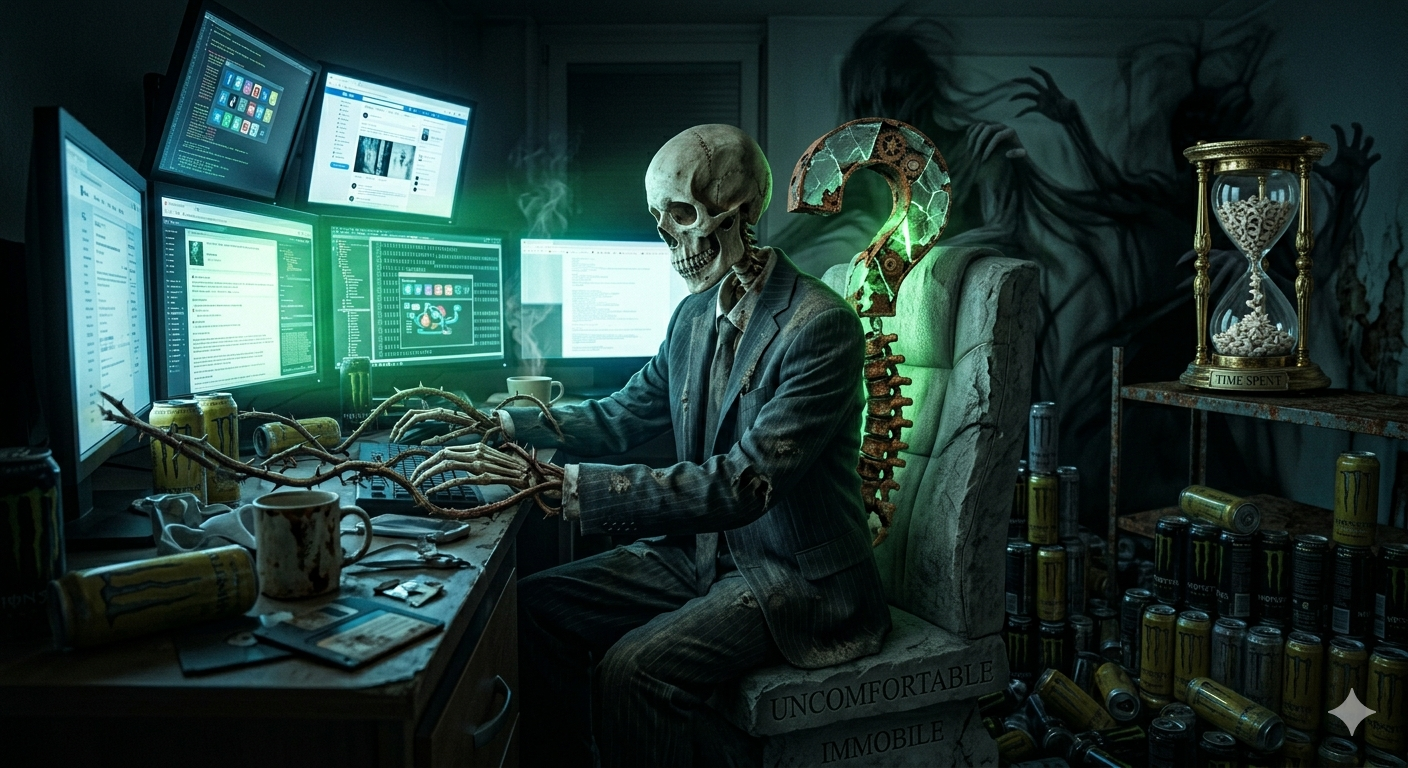
The first step toward a successful decline is the choice of seating. Ignore anything with lumbar support or breathable mesh backs. What you need is a chair that combines the consistency of a hard park bench with the instability of a unicycle. Or better yet: a worn-out sofa that literally sucks you in until your chin rests on your sternum and your knees are higher than your hips. This is the "C-Curve of Power." In this position, you signal to your intervertebral discs that their time as shock absorbers is officially over.
Let’s move to the monitor. Common teaching says the top edge should be at eye level. Ridiculous! Place your screen either so low that you have to stare down like a vulture at its prey, or—for the advanced—at an angle to the side on a stack of old catalogs. The goal is permanent torsion. A slightly twisted neck over eight hours ensures asymmetrical stress that transforms your cervical vertebrae into a fascinating, spiral-shaped sculpture. When it cracks like an old horror movie as you look over your shoulder, you know you're on the right track.
And let's not forget the peripherals. The keyboard should be so far away that you have to spread your arms like an albatross, while the mouse lingers in a place reachable only by extreme hyperextension of the wrist. We call this "Carpal Tunnel Roulette." Every tingling in your fingers is a small round of applause from your body for your consistent rejection of any natural posture. We don't save energy through efficiency here, but through total rigidity. Who needs dynamics when they can remain in the stiffness of a prehistoric fossil? Enjoy the decline—your body will bend until it breaks!
The positive motivation with a medical/technical explanation: Do you feel that dull pull in your lumbar spine or the stinging pain between your shoulder blades? That’s not just "muscle soreness"; it’s a biological cry for help before structural failure.
Technically, this "ergonomics of decline" leads to massive misalignment of the intervertebral discs (Disci intervertebrales). The permanent C-curvature of your spine creates enormous hydrostatic pressure on the anterior part of the discs. The gelatinous core (Nucleus pulposus) is pressed backward against the nerve tissue—the precursor to a herniated disc.
Simultaneously, your musculature suffers ischemic stress. Since the muscles in the neck and back are permanently tensed to maintain the unnatural head position, the capillaries are squeezed shut. The oxygen supply is interrupted, and metabolic waste products like lactate cannot be transported away. The result is myogelosis—a painful, palpable hardening of the muscle tissue. Long-term, this leads to an atrophy of the supporting deep muscles, making your skeleton unstable and driving you into a downward spiral of pain and even more protective posturing.
The good news: your body is plastic! Even small changes—like dynamic sitting (frequent position changes) or aligning the monitor at eye level—abruptly reduce the pressure on your vertebrae by up to 50%. Your connective tissue needs movement to stay hydrated. As soon as you stand up and stretch, your discs literally "drink" new nutrient fluid. Stop bending your spine. An upright body is the basis for a clear mind and real, vital energy!
This satirical article does not replace medical advice. For real guidance, see the English guide overview or the German knowledge pages.