
2 min read · MOMUS
Hostage-taking in the frontal lobe: Why we lose control – and how to take it back.
We believe we are the masters of our own house, yet in the basement, a Stone Age brain is throwing a tantrum, wanting nothing but pizza and cat videos. An analysis of the biochemical mutiny in your head and the battle plan for your mental reconquest.
MOMUS articles are satire and deliberately recommend the opposite of healthy behavior. They are a mindset mirror, not health advice.
Hand on heart: How many times today have you intended to "just quickly" check something, only to wake up 45 minutes later in a rabbit hole about the breeding habits of deep-sea jellyfish? We live in an illusion of autonomy. We think we are making decisions, while in truth we are being remote-controlled by an ancient, instinct-driven operating system that is as overwhelmed by the modern world as a medieval peasant in a disco.
This loss of control is no coincidence, nor is it a character flaw—it is a design flaw of evolution. Our brain is programmed to save energy (hello, couch!), scan for danger (hello, doomscrolling!), and seek quick rewards (hello, sugar!). In the savannah, this was vital for survival. Today, in the age of abundance and algorithms, it is our undoing. Tech corporations have hacked our biological vulnerabilities. They feed our "inner weaker self" with digital fast food until it has become so fat and sluggish that it can no longer find the exit.
We are losing control because we have given up resistance. It is so much more comfortable to drift. The "tyranny of the moment" has us firmly in its grip. We only react instead of acting. We are like pinballs tossed between notifications and cravings. But the worst part is: we have grown accustomed to the chaos. We call it "stress," "work-life balance issues," or simply "modern life." In truth, it is a surrender to our own base instincts.
But here is the good news: the inner beast may be sitting in the executive chair, but it doesn't have the access codes to the vault. We can regain control, but not through force or self-hatred. We must learn to outsmart the operating system that loves to sabotage us.
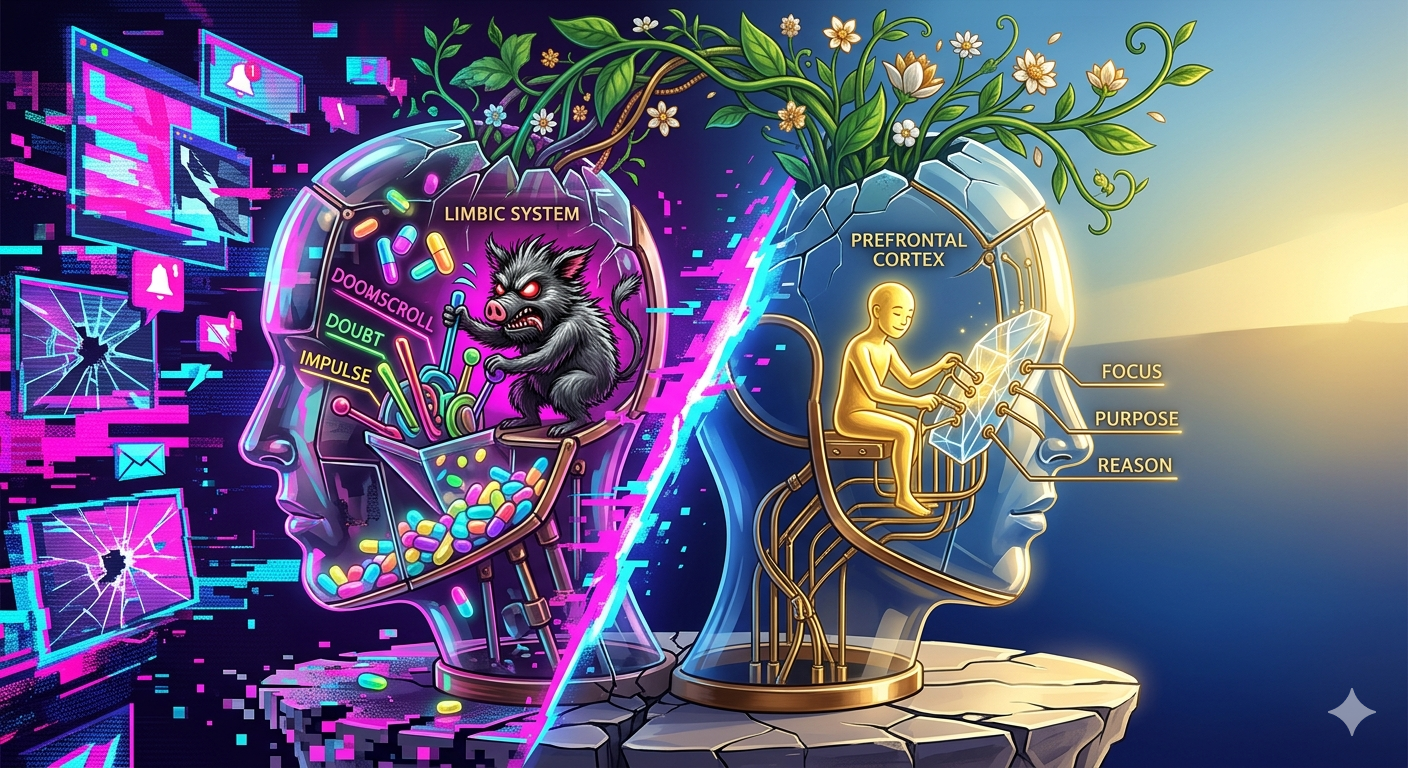
The positive motivation with a medical/technical explanation Why do you often feel so powerless against your bad habits? It's due to the eternal battle between your limbic system (the emotional reward center) and your prefrontal cortex (the seat of reason and logic).
When you are under stress, tired, or your blood sugar is on a roller coaster, the prefrontal cortex is literally "paralyzed." Your brain switches to autopilot, and the limbic system takes the helm. It wants dopamine, and it wants it now! That’s why you reach for chocolate or your smartphone, even though you know better. Your brain uses the path of least resistance (neural pathways) that you have strengthened over years of repetition.
But you have the power to reprogram: Through neuroplasticity, your brain can build new pathways. Every time you pause (for just 5 seconds!) before giving in to a bad habit, you strengthen the connection to your prefrontal cortex. This is called the "gap" between stimulus and response.
The trick: Make bad habits harder (phone in another room) and good ones easier (lay out gym clothes).
Technically speaking: You are lowering the "activation energy" for positive actions.
The reward: As soon as you realize that YOU are deciding—not your dopamine levels—your body releases endorphins, which provide a much more sustainable sense of happiness than any sugar rush. You are the programmer, not the software!
This satirical article does not replace medical advice. For real guidance, see the English guide overview or the German knowledge pages.