
3 min read · MOMUS
Social Isolation 2.0: Why people are just pixels in the way of your happiness
Real encounters are unpredictable, loud, and require deodorant. Learn how to transform your life into a hermetically sealed echo chamber and why total digital isolation represents the highest form of emotional efficiency.
MOMUS articles are satire and deliberately recommend the opposite of healthy behavior. They are a mindset mirror, not health advice.
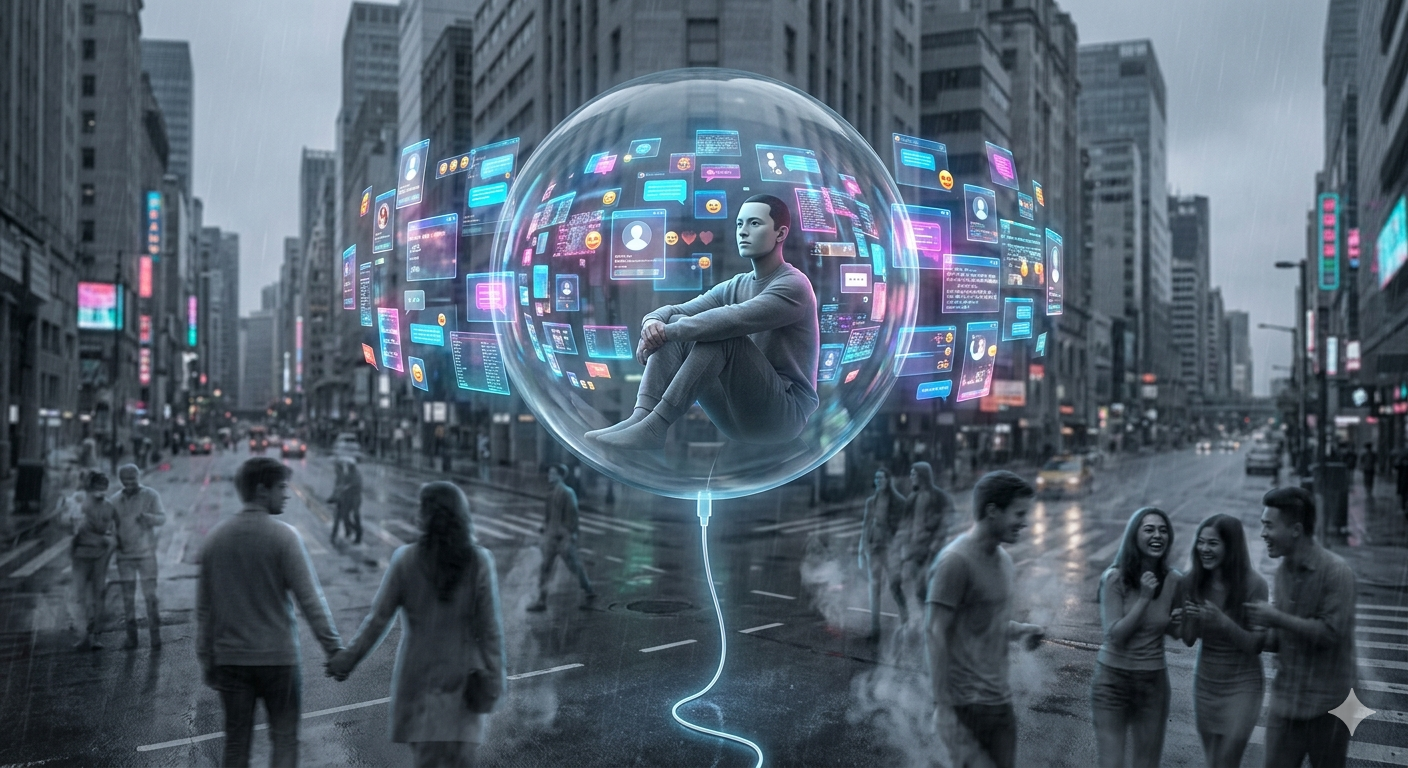
Have you touched a real human being today? Or even worse: did you have to look a stranger in the eye and engage in a harmless conversation about the weather? If so, my deepest condolences. You wasted precious lifetime that you could have invested much more efficiently in scrolling through the filtered lives of strangers. Welcome to the era of "Social Isolation 2.0." We celebrate the retreat into the digital fortress, where other people only exist as two-dimensional clusters of pixels that can be easily deleted with a swipe of a thumb.
Real social interaction is a logistical nightmare. You have to coordinate schedules, interpret facial expressions, and—the absolute horror—show empathy. This is mental high-performance sports, for which we no longer have capacity in our optimized world. Why should you expose yourself to the risk of real disappointment or uncomfortable contradiction when your algorithm understands you so much better than any lifelong friend? Digital loneliness is not a deficit; it is a premium upgrade. We sell you isolation as "self-care" and social phobia as an "exclusive lifestyle."
In your digital cocoon, you are the director. You can end conversations via "ghosting" before they get complicated, and collect recognition in the form of heart icons that flood the reward center much faster than a real, profound compliment. We have replaced the "we" with "me.exe." People in real life are messy; they have needs, they sometimes smell funny, and they expect answers in real time. Pixels, on the other hand, are clean. They demand nothing except a little battery life.
The art of isolation consists of framing the silence not as a void, but as "total autonomy." Who needs a village to raise a child or lead a life when you have a high-speed network? We cultivate loneliness until it feels like freedom. That we lose the ability to solve a conflict without a block button or forget what a hug feels like that doesn't consist of an emoji is a small price to pay for absolute control over our social interface. Stay in your room. The world outside is too bright, too loud, and far too real anyway.
The positive motivation with a medical/technical explanation: Does your digital freedom sometimes feel strangely heavy and hollow? That is your brain suffering from the withdrawal of real oxytocin release.
Technically, humans are "obligate gregarious" beings—we are biologically programmed for cooperation and physical proximity. Social isolation activates the same areas in the brain as physical pain (the Anterior Cingulate Cortex). Chronic loneliness is not a psychological luxury problem, but a biological stressor that permanently increases cortisol release. This leads to a weakening of the immune system and increases the risk of cardiovascular disease by approximately 29%.
Particularly fatal: without real interaction, your mirror neuron system atrophies. You lose the ability to read and react to the emotions of others. The result is a social atrophy that drives you into a downward spiral of anxiety and even more withdrawal. Your brain switches to a hypervigilant state—you begin to see a threat in every neutral gesture. A lack of real social contact has the same negative effect on life expectancy as smoking 15 cigarettes a day.
The good news: your brain is neuroplastic! Even a single real, profound interaction per day can lower cortisol levels and boost the production of oxytocin (the bonding hormone). Oxytocin acts as a shield against stress and literally repairs damage in your cardiovascular system. There is no digital substitute for the bio-electrical resonance between two people. Go out, seek eye contact, risk a conversation. Your brain needs the "we" to stay healthy as an "I"!
This satirical article does not replace medical advice. For real guidance, see the English guide overview or the German knowledge pages.