
3 min read · MOMUS
The Art of Kinetic Denial: Why your body loves statics
Exercise is completely overrated. Why laboriously waste energy when you can achieve the perfection of standstill? Let’s dive into the evolution of the "sitting species" and the biological elegance of total inactivity.
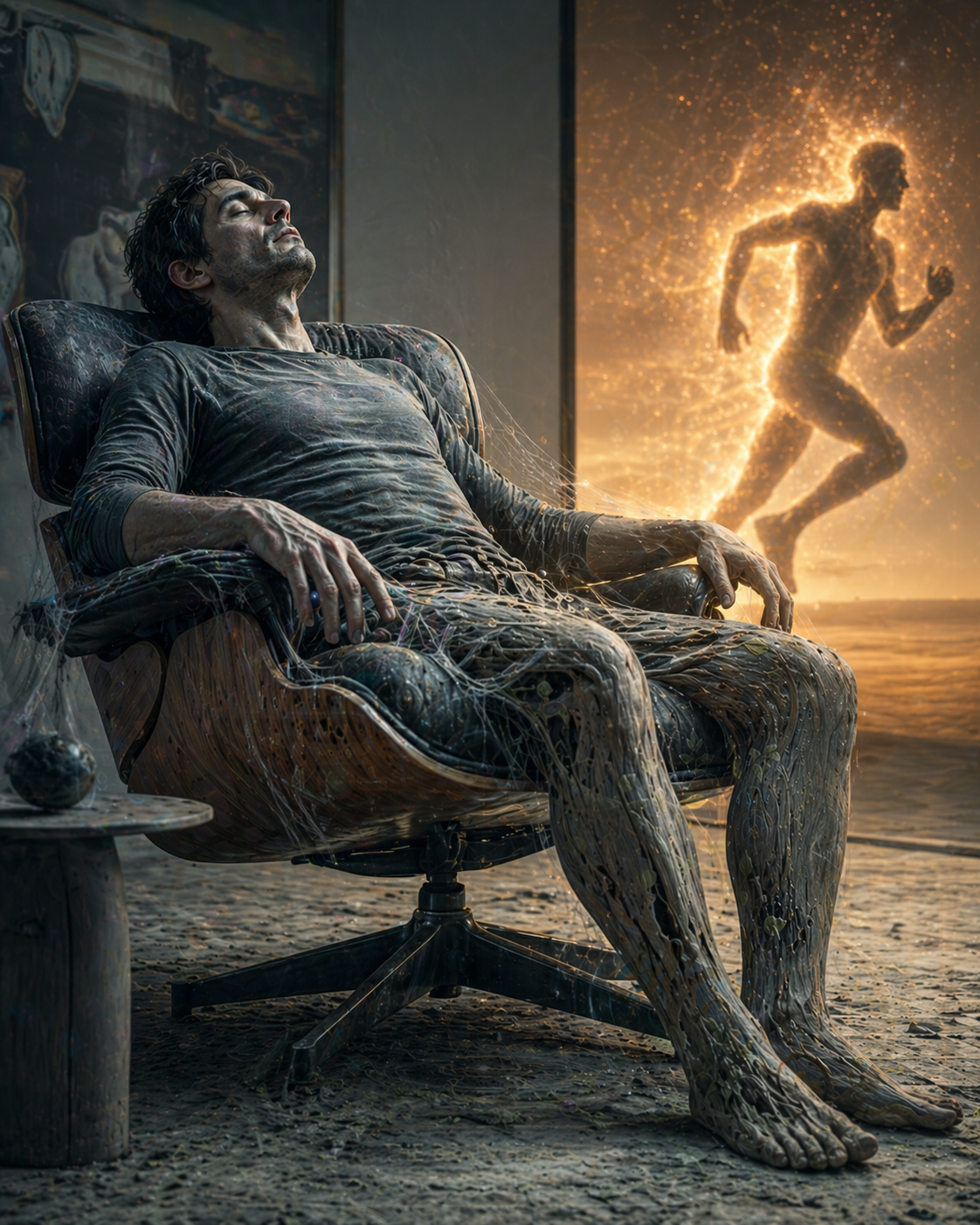
MOMUS articles are satire and deliberately recommend the opposite of healthy behavior. They are a mindset mirror, not health advice.
Have you ever wondered why we have legs? The modern fitness industry wants us to believe they are for running, jumping, or—heaven forbid—burpees. But if we are honest with our "inner weaker self," we know: legs are actually only there to carry us from the parking lot to the elevator or to change positions while sitting when our backside falls asleep.
Welcome to the era of kinetic denial. In a world obsessed with step counters and heart rate zones, we dare to take the radical step back: standstill. It is a form of biological stinginess that we celebrate here. Why burn valuable glycogen for a run in the woods when you can invest it for hard times (or the next buffet) in the form of visceral gold—also known as belly fat?
Consider the "advantages" of absolute physical inactivity. While joggers torture themselves through the mud in the rain and maltreat their joints with every impact, we enjoy the safety of upholstered furniture. We are the structural engineers of everyday life. Our energy consumption is so optimized that even a houseplant looks like a high-performance athlete in comparison. This isn't laziness; it is energetic minimalism.
The psychology behind it is brilliant: every avoided staircase is a small victory over the tyranny of discipline. We haven't just found the "path of least resistance"; we've paved it and built a comfortable skateboard on it. Movement is restlessness; standstill is peace. Why should we put the body under stress by driving the pulse into regions where you can no longer comfortably chat about the latest streaming series?
We cultivate horizontal movement and perfect "passive sitting." We are the heirs of evolution who realized that you no longer have to hunt the mammoth—you can have it delivered. And while the world outside runs, we sit here and watch time pass while our muscles turn into a soft, moldable mass that adapts perfectly to every sofa edge. A triumph of adaptability!
The positive motivation with a medical/technical explanation: Does the heaviness in your limbs feel almost cozy after reading this? That is the sweet trap of atrophy.
Medically speaking, you are committing a slow theft of your own life force. When you don't move, technically the following happens: your heart, actually a high-performance muscle, becomes smaller and less efficient (cardiac atrophy). Your stroke volume decreases, meaning your heart must beat more often to pump the same amount of blood—you are more stressed at rest than an athlete under load.
At the same time, your mitochondria, the power plants of your cells, waste away. Since no energy demand is signaled, the body reduces the production of these units. The result? You feel chronically tired because your body has forgotten how to produce energy efficiently. Your joints "rust" because the joint fluid (synovia) is only massaged into the cartilage through movement. Without movement, your cartilage literally starves.
But here is the turning point: your body is an adaptive machine. As soon as you begin to walk briskly for even 10 minutes, your brain fires off BDNF (Brain-Derived Neurotrophic Factor)—a fertilizer for your nerve cells. Your mitochondria begin to multiply, and your metabolism switches from "storage mode" to "burn mode." You reclaim control over your biology. Exercise is not a punishment program for what you ate, but a celebration of what your body can achieve. Get up—your heart is waiting for the challenge!
This satirical article does not replace medical advice. For real guidance, see the English guide overview or the German knowledge pages.