
4 min read · MOMUS
The Sweet Ecstasy of the Crash: A Tribute to the Sugar Coma
Forget balanced meals and stable blood sugar levels! True freedom lies in ruthless excess. We celebrate the art of flooding the body with sugar, only to enjoy the glorious, inevitable crash. An advanced guide to self-sabotage that will make your inner weaker self howl with joy.
MOMUS articles are satire and deliberately recommend the opposite of healthy behavior. They are a mindset mirror, not health advice.
Welcome, dear disciples of hedonism, dear gourmets of the gross! Let us sing a hymn today to the most underrated state of modern existence: the sugar coma. In a world obsessed with "clean eating," "low carb," and the tyrannical dictatorship of stable blood sugar levels, we dare to speak the sweet, sticky truth. Stability is boring. Who wants an engine that purrs evenly when it can instead roar, sputter, and finally explode in a cloud of insulin secretion?
The sugar coma is not just a state; it is an art form. It requires dedication, timing, and the absolute refusal of any moderation. It begins with the conscious decision to leave the whole-grain bread behind and instead embrace the bag of gummy bears – or better yet, drape the gummy bears on a donut, which in turn swims in caramel sauce. Why settle for a gentle hill when you can climb the Mount Everest of blood sugar?
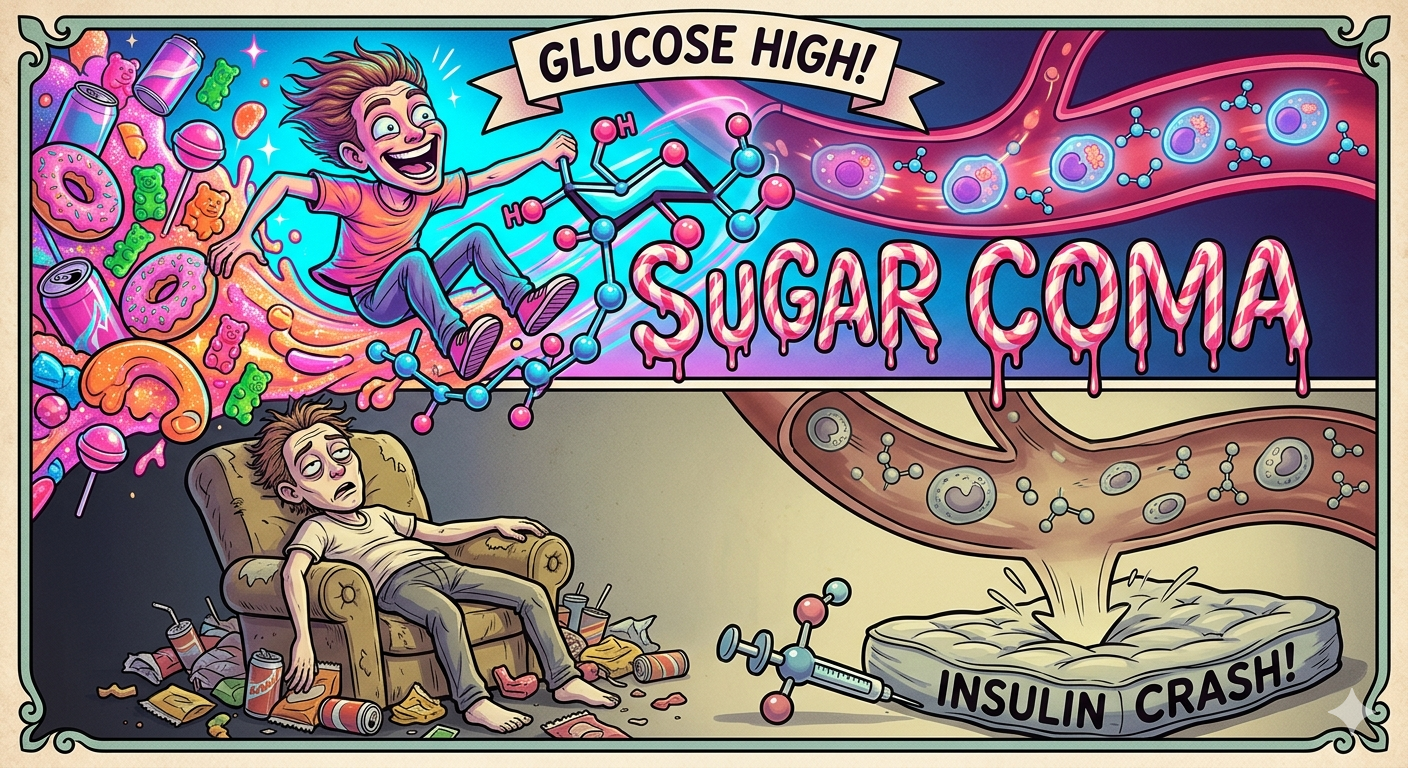
The ascent is intoxicating. A rush of glucose floods the bloodstream. The brain, that junkie organ, bathes in dopamine. You feel invincible, lightning-fast in thought, full of energy – for exactly eleven minutes. It is the moment you believe you could learn a new language or run a marathon, while in reality, you are just typing faster and laughing louder. This phase is the glittering bait that lures us back onto the hook time and again.
But the true connoisseur knows: the ascent is only the prologue. The real magic happens during the crash. Because what goes up must come down, and in the world of sugar, this fall is steep, merciless, and strangely satisfying. It is the moment when the pancreas, panicked by the glucose tsunami, pumps liters of insulin into the blood. Suddenly, as if someone had pulled the plug, the party is over.
Blood sugar levels rattle into the basement, lower than the moral standards of a used car salesman. Euphoria gives way to leaden fatigue. Eyelids grow heavy, thinking becomes clouded, and a strange irritability spreads. You begin to start sentences with "I just want to..." without ever finishing them because the energy for the last word is missing. It is a collective surrender of the body, a silent agreement between brain and muscles to temporarily cease operations.
And isn't that wonderful? In a meritocracy that demands constant optimization, the sugar coma is the ultimate act of rebellion. It is the conscious decision not to function. It is the freedom to lie drooling on the sofa, unable to operate the remote control, while the body desperately tries to manage the chaos. This lethargy has an almost meditative quality. It is the zero point of productivity, a place where deadlines and obligations have no power.
Sure, there are side effects. The food cravings that follow just a few hours later are legendary. The remorse when you realize you ate the entire giant pack of chips after the bag of gummy bears is real. But that’s part of it. It’s a cycle. A loop of intoxication and regret that makes life truly... well, sticky. So why lead a balanced life when you can ride a roller coaster instead? Buckle up, folks. The next round is on the pancreas.
The positive motivation with a medical/technical explanation: Well, did you recognize yourself? Did you enjoy that cozy-ghastly feeling of the sugar crash? Great. Then you now know what it feels like to intentionally sabotage your body.
Here is the medical reality behind your "sweet ecstasy": When you flood your body with simple carbohydrates and sugar, your pancreas has to work overtime to secrete massive amounts of insulin. Insulin is the key that unlocks the cells so they can absorb glucose (sugar) from the blood. The problem? Due to the massive release, your blood sugar often drops far below normal levels. This is the moment of the "crash" – you feel sluggish, unfocused, and irritable (reactive hypoglycemia).
But that’s not all. If you repeat this cycle constantly, your cells become desensitized. They ignore the insulin (insulin resistance). Your body must produce more and more insulin to achieve the same effect. This is the direct path to type 2 diabetes, chronic inflammation in the body that damages your vessels and drastically increases your risk of cardiovascular disease. Your brain is also affected; these sugar fluctuations are like a roller coaster ride for your mood and cognitive abilities.
But hey, the good thing is: You are in control! Now that you know how this destructive process works, you can consciously choose against it. You don't have to be controlled by your blood sugar. Start fueling your body with complex carbohydrates (whole grains, vegetables) and healthy fats. These are digested more slowly, the glucose is released into the blood bit by bit, and your blood sugar remains stable. This means: no dramatic energy crashes, no food cravings, better concentration, and a healthier body in the long run that won't let you down. It’s your choice – roller coaster or a smooth glide?
This satirical article does not replace medical advice. For real guidance, see the English guide overview or the German knowledge pages.