
3 min read · MOMUS
Doomscrolling as Meditation: Enlightenment in the Digital Trash-Abyss
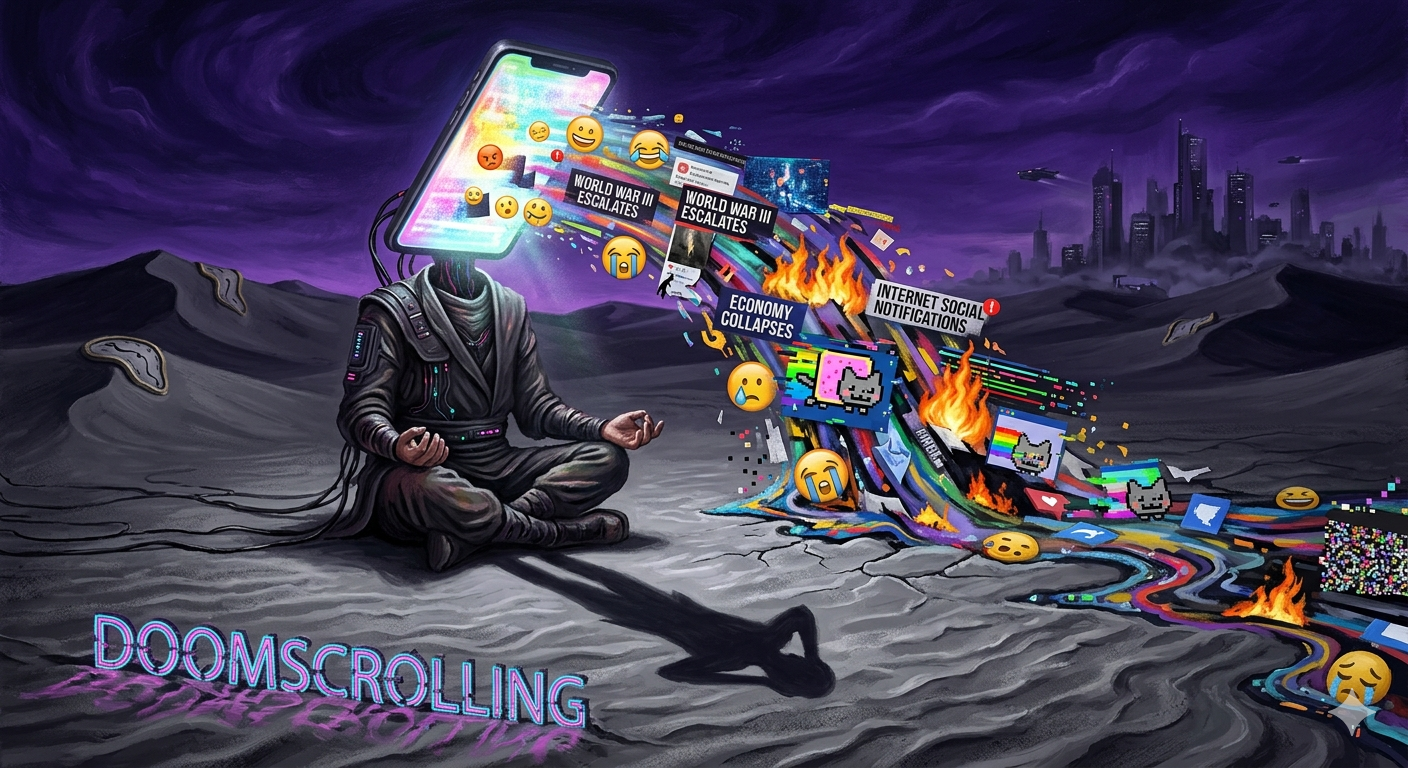
Who needs Zen gardens when you can have the end of the world in 15-second intervals? A guide to brain freeze: why endless scrolling through catastrophes is the most effective method to silence your own soul.
MOMUS articles are satire and deliberately recommend the opposite of healthy behavior. They are a mindset mirror, not health advice.
Forget breathing exercises. Ignore the silence. Who actually claimed that an "empty head" should be the goal? We know better: a head is only truly safe when it is stuffed so full of digital waste that not a single original thought can fit inside. Welcome to the high school of doomscrolling – the modern meditation for the stressed nihilist.
The principle is captivatingly simple: take a smartphone, open a social media app of your choice, and move your thumb in a rhythmic, almost hypnotic downward motion. The goal? To find the "bottom" of the internet (spoiler: there isn't one). While real monks train for years to dissolve the ego, we manage it in five minutes on the "porcelain throne." We don't dissolve into love, but into a flood of bad news, absurd conspiracy theories, and videos of people doing things we neither understand nor need.
Why is doomscrolling so effective? Because it keeps the brain in a permanent state of "alarmed paralysis." We consume disaster reports from distant lands, followed by a video of a dancing hamster, immediately followed by a hateful comment thread about the correct way to cook pasta. This cognitive dissonance is like a blender for the psyche. After thirty minutes, the brain is so finely pureed that you can't even remember why you were sad in the first place – or who you even are.
It is the ultimate escape from oneself. In the silence, questions lurk: "Am I happy?", "What am I doing with my life?" In doomscrolling, only one question lurks: "What happens next?" The algorithm is our spiritual guide. It knows our deepest fears and serves them to us on a shiny tray of pixels. We bathe in the collective anxiety of humanity, and the best part is: we don't have to do anything. We are passive observers of the downfall, while our thumb remains the only connection to reality.
Some call it a waste of time; we call it "mental overload protection therapy." When your head is so full of other people's trash, there's no room for your own problems. It is the cheapest drug in the world, and the side effects – loss of concentration, sleep disorders, and a general aura of world-weariness – are just small souvenirs from our journey into the digital abyss.
The positive motivation with a medical/technical explanation: Do you feel the urge right now to quickly click away from this text to see what's new on Twitter or TikTok? That's no coincidence. That's chemistry.
Technically speaking, you are abusing your reward system. Every time you scroll and discover something new (no matter how terrible), your brain releases dopamine. This is the "reward neurotransmitter" that was actually intended to motivate us to learn or reproduce. With doomscrolling, it is misappropriated: your brain becomes addicted to the next nugget of information.
At the same time, your amygdala – the fear center in the brain – fires continuously. Since you are constantly consuming negative or threatening information, your body remains in a state of chronic micro-stress. Your cortisol levels rise slightly, which in the long run weakens your immune system and reduces the plasticity of your brain (the ability to learn and concentrate). Your prefrontal cortex, responsible for logic and self-control, is effectively switched "offline."
The good news: you can pull the plug! Your brain is neuroplastic, meaning it can reprogram itself. Even a "digital diet" of just 20 minutes of real silence or reading a physical book allows your nervous system to calm down. Once the dopamine fireworks subside, your ability to concentrate returns. You are not a slave to the algorithm. Your focus is your most valuable resource – start managing it yourself again!
This satirical article does not replace medical advice. For real guidance, see the English guide overview or the German knowledge pages.